July 12, 2026 · Autoriax
How to Build a Semi-Autonomous AI Content Workflow That Actually Maintains E-E-A-T
Learn how to build a semi-autonomous AI content workflow that maintains E-E-A-T. Balance automation with human expertise to scale safely.

In the rapidly evolving landscape of digital marketing, businesses face a critical dilemma: how to scale content production using artificial intelligence without compromising quality. Many organizations rush into full automation, only to find their search rankings penalized for lacking depth and accuracy. The solution lies not in choosing between speed and quality, but in engineering a hybrid system. Learning how to build a semi-autonomous AI content workflow that actually maintains E-E-A-T is essential for sustainable growth. This approach leverages AI for efficiency while retaining human oversight for expertise and trust.
This guide provides a professional framework for integrating Experience, Expertise, Authoritativeness, and Trust (E-E-A-T) into your automation architecture. By designing workflows that enforce quality gates, businesses can produce high-volume content that satisfies both search algorithms and human readers. The following sections detail the specific steps required to implement this balanced strategy effectively.
Quick Facts: How to Build a Semi-Autonomous AI Content Workflow That Actually Maintains E-E-A-T
- Semi-autonomous workflows combine AI speed with human verification to ensure accuracy.
- Google’s Search Quality Rater Guidelines emphasize experience and trust over pure volume.
- Effective workflows require automated fact-checking gates before human review occurs.
Understanding E-E-A-T in the Age of AI
E-E-A-T stands for Experience, Expertise, Authoritativeness, and Trust, serving as the cornerstone of Google’s quality assessment framework. In the context of artificial intelligence, these signals must be deliberately engineered rather than assumed. Content generated without human oversight often lacks the nuanced experience that search engines reward. Therefore, understanding how these factors interact with automation is the first step toward compliance.
Defining Experience, Expertise, Authoritativeness, Trust
Experience refers to the first-hand knowledge an author possesses regarding the topic. Expertise relates to the formal qualifications or deep understanding demonstrated in the content. Authoritativeness is the reputation of the website and the author within the industry. Trust involves the accuracy, honesty, and safety of the information provided. When building a workflow, each of these pillars requires specific validation steps.
Why Full Automation Fails Quality Standards
Fully autonomous agents often hallucinate facts or miss subtle contextual cues required for high-trust topics. Without human intervention, AI may generate plausible-sounding but incorrect statements. This leads to a degradation of trust signals over time. Search engines increasingly detect patterns of low-effort automation, resulting in visibility losses for sites that rely solely on machines.
Key Takeaway: E-E-A-T signals must be intentionally designed into the workflow, as AI cannot inherently possess human experience or professional reputation.
Designing the Semi-Autonomous Architecture
Designing the semi-autonomous architecture requires a clear division of labor between machine efficiency and human judgment. The goal is to automate repetitive tasks while reserving critical decision-making for skilled editors. This structure ensures that the content scales without losing the human touch necessary for high-quality ratings.
The 80/20 Rule for AI and Human Input
A successful model typically allocates 80% of the workload to AI and 20% to humans. AI handles data aggregation, initial drafting, and formatting. Humans focus on verifying claims, adding personal anecdotes, and approving final publication. This ratio maximizes throughput while keeping quality control manageable for content teams.
Setting Up Automated Research Gates
Automated research gates force the system to retrieve information from verified sources before drafting begins. Prompts should be engineered to require citations from authoritative domains. If the AI cannot find sufficient evidence, the workflow should halt and flag the topic for manual research. This prevents the generation of unsubstantiated content at the source.
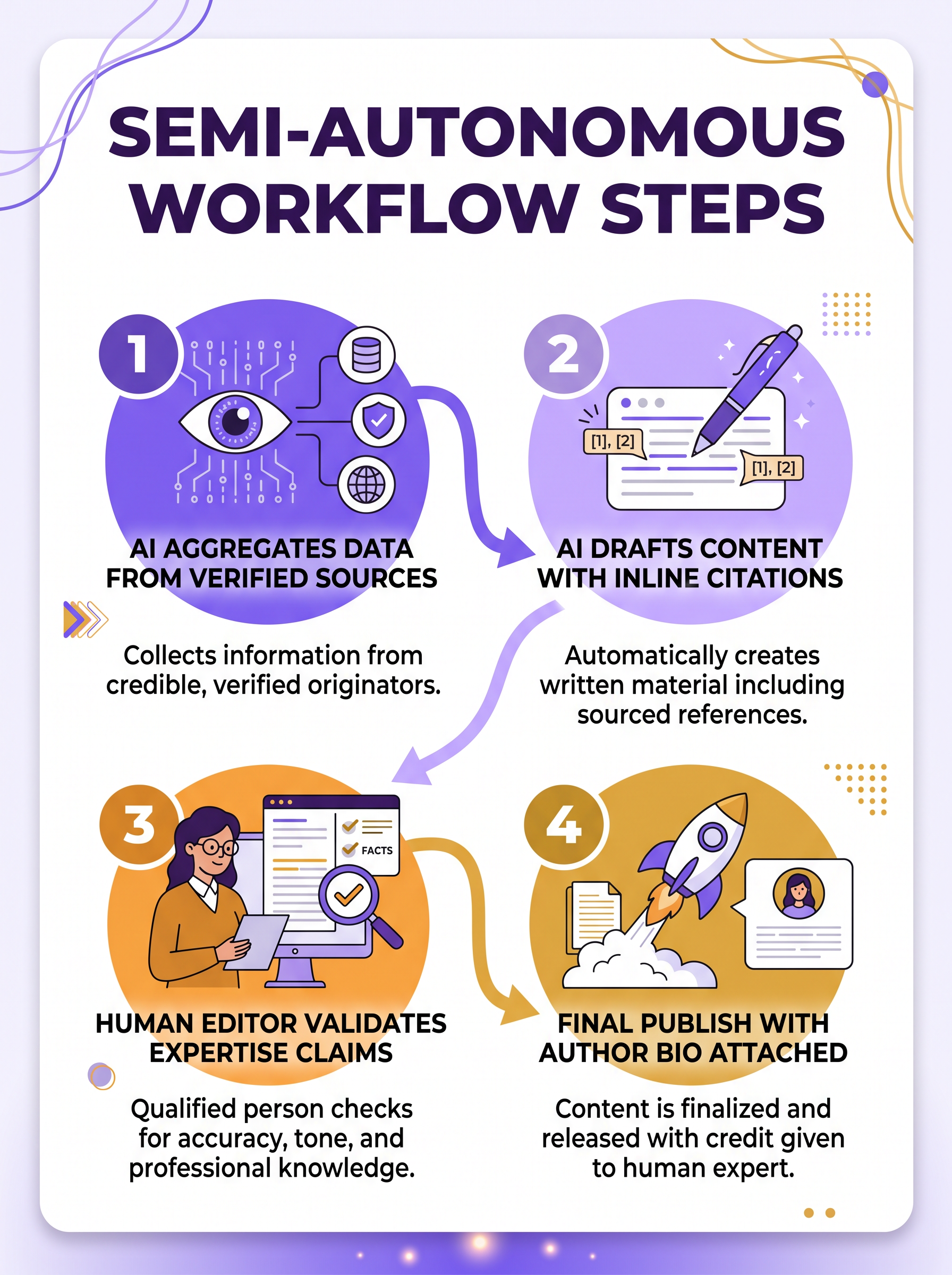
Key Takeaway: Allocating the majority of drafting to AI while reserving validation for humans creates an efficient yet trustworthy production line.
Frequently Asked: What is the ideal split for AI vs human work?
The ideal split is generally 80% AI for research and drafting, and 20% human for expertise validation. This ensures efficiency without sacrificing the trust signals required for high rankings.
Embedding Verification Steps into the Workflow
Embedding verification steps into the workflow ensures that accuracy is checked before content reaches the public eye. These steps act as safety nets to catch errors that automated systems might miss. By institutionalizing fact-checking, businesses can maintain high standards even at scale.
Automated Fact-Checking Protocols
Automated protocols can cross-reference claims against known databases or trusted APIs. Scripts can be written to flag statistics that lack source attribution. This technical layer reduces the burden on human editors by filtering out obvious errors early. It ensures that only content with verified data moves to the review stage.
Human Review Triggers for YMYL Topics
Your Money or Your Life (YMYL) topics require stricter scrutiny due to their potential impact on user well-being. Workflows should automatically route health, finance, and legal content to subject matter experts. General content may pass with standard editing, but high-risk topics demand specialized validation. This differentiation protects the brand from liability and reputation damage.
Key Takeaway: Verification steps must be tiered, with stricter human review protocols applied to high-risk YMYL content categories.
Maintaining Brand Voice Consistency
Maintaining brand voice consistency is crucial for building recognition and trust across all content channels. AI models can be tuned to mimic specific tones, but they require clear guidelines to stay on brand. Consistency ensures that every piece of content feels like it comes from the same reliable source.
Training AI on Brand Guidelines
Brand guidelines should be converted into structured prompts that define tone, style, and vocabulary. Examples of preferred writing styles can be fed into the model during the setup phase. Regular updates to these guidelines ensure the AI adapts to evolving brand messaging. This training reduces the need for heavy editing later in the process.
Style Guardrails and Tone Checks
Style guardrails act as constraints that prevent the AI from deviating from established norms. Automated tools can scan drafts for prohibited phrases or inconsistent terminology. If a draft violates these guardrails, it is returned for revision before human review. This maintains a professional and unified voice across all published materials.
Key Takeaway: Consistent brand voice is achieved by encoding style guidelines directly into the AI prompting and validation layers.
Structuring Authorship and Attribution
Structuring authorship and attribution correctly is vital for signaling expertise to search engines. Clear attribution links content to real people with verifiable credentials. This transparency builds trust with both users and algorithmic raters.
Dynamic Author Bio Integration
Dynamic author bios should be automatically appended to articles based on the assigned editor or expert. These bios must include relevant credentials and links to professional profiles. Automation ensures that no article is published without proper attribution. This consistency reinforces the authority of the content repository.
Managing Inline Citations Automatically
Inline citations should be generated by the AI during the drafting phase based on retrieved sources. The workflow must verify that every claim has a corresponding link to a reputable domain. Broken links or low-quality sources should trigger an alert for the editor. This systematic approach ensures transparency and accountability in every piece.
| Feature | Fully Autonomous Workflow | Semi-Autonomous Workflow |
|---|---|---|
| Speed | Very High | High |
| Accuracy | Low to Moderate | High |
| E-E-A-T Compliance | Poor | Strong |
| Human Oversight | None | Critical Review Gates |
| Risk of Penalties | High | Low |
Key Takeaway: Proper authorship structures and automated citations are non-negotiable elements for maintaining trust in an AI-assisted workflow.
Monitoring Performance and Quality Metrics
Monitoring performance and quality metrics allows teams to refine their workflows over time. Data-driven insights reveal where the automation is succeeding and where it is failing. Continuous improvement is necessary to adapt to changing search engine standards.
Tracking E-E-A-T Signals Over Time
Teams should track metrics related to user engagement and trust, such as bounce rates and return visits. Search console data can indicate how well content is performing in terms of visibility. Declines in these areas may suggest a need for tighter quality controls. Regular audits ensure the workflow remains aligned with quality goals.
Adjusting Workflow Based on Data
If specific topics consistently require heavy editing, the AI prompts should be adjusted accordingly. Data might show that certain sources are more reliable than others, prompting a change in research parameters. Flexibility in the workflow design allows for rapid adaptation to performance insights. This iterative process keeps the content strategy effective long-term.
Frequently Asked: How do you measure E-E-A-T success?
Success is measured by tracking organic visibility, user engagement metrics, and the frequency of manual corrections needed. High trust signals correlate with sustained traffic growth.
Key Takeaway: Continuous monitoring of performance data is essential for optimizing the balance between automation efficiency and content quality.
Future-Proofing Your Content Strategy
Future-proofing your content strategy ensures longevity amidst algorithm updates and technological shifts. A rigid workflow may break when search engines change their ranking criteria. Building flexibility into the system allows for sustainable growth without constant overhauls.
Adapting to Algorithm Updates
Search algorithms frequently update to prioritize higher quality signals. A semi-autonomous workflow can be tweaked to emphasize new requirements quickly. For example, if experience becomes more weighted, the human review step can be expanded. This adaptability protects the investment in content infrastructure.
Scaling Without Sacrificing Quality
Scaling requires adding more volume without diluting the quality standards established initially. By keeping the human review bottleneck focused on high-value tasks, teams can handle increased output. The system grows with the business while maintaining the integrity of the brand. This balance is key to long-term market leadership.

Key Takeaway: A flexible workflow design allows businesses to scale content production while remaining resilient to industry changes.
Conclusion
Building a robust content strategy requires more than just adopting the latest tools; it demands a thoughtful integration of technology and human insight. By learning how to build a semi-autonomous AI content workflow that actually maintains E-E-A-T, organizations can achieve scale without sacrificing credibility. The key lies in embedding verification steps, maintaining clear authorship, and respecting the limits of automation.
Businesses that implement these structured workflows will find themselves better positioned to withstand algorithm updates and earn user trust. The future of content creation is not about replacing humans, but empowering them with efficient tools. Take the next step by auditing your current processes and identifying where human oversight can be reintroduced to enhance quality. Start designing your semi-autonomous system today to secure your digital presence for the long term.
Sources
- Content based on industry best practices and public search quality guidelines.
- Google Search Quality Rater Guidelines (General Reference).
- Industry standards for AI content governance and workflow management.
Try Autoriax free — no credit card required
Get your first article in minutes. See the research depth before you commit.
Get 3 free articles3 articles free • No credit card • Cancel anytime