July 15, 2026 · Autoriax
Automatic Research Tools That Feed Your AI Content Pipeline (Without Plagiarism)
Discover automatic research tools that feed your AI content pipeline without plagiarism. Learn how to automate fact-finding, citations, and verification…

How do you automate research for AI content without plagiarism? The answer lies in deploying dedicated research tools that pull from licensed databases, cross-reference claims against original sources, and generate inline citations automatically—before any drafting begins. Platforms like Perplexity, Elicit, and Scite are purpose-built for this, ensuring your AI content pipeline receives verified data rather than regurgitated text. A 2025 industry study found that 68% of marketers using AI content tools worry about accidental plagiarism, yet most automation guides skip the research phase entirely.[2] This article breaks down how to build an ethical, plagiarism-free research layer that feeds your AI drafting engine with trustworthy, cited information.
Quick Facts: Automatic Research Tools That Feed Your AI Content Pipeline (Without Plagiarism)
- Over 125 million academic papers are searchable via Elicit, enabling structured data extraction without manual database queries.[4]
- The AI detector market is projected to reach $2.06 billion by 2030, signaling platform-level investment in identifying unverified or synthetic content.[18]
- Ethical research automation reduces fact-checking time by up to 70% in enterprise workflows when integrated with human-in-the-loop verification.[2]
The Hidden Risk in AI Content Workflows
Most content automation guides focus heavily on drafting and publishing, often neglecting the critical research phase where plagiarism risks are highest. When AI models generate text based on unverified training data, they may inadvertently reproduce copyrighted material or present outdated information as fact.[2]
Why Drafting Isn’t Enough
Generative AI excels at syntax and structure but lacks inherent truth verification. Without a dedicated research layer, the AI is essentially guessing based on probability. This means that even well-written articles can contain fundamental errors—statistics that don’t exist, quotes attributed to the wrong people, or facts pulled from outdated training corpora. Teams must recognize that drafting is only the final mile of the content journey, not the starting point.[2]
The Cost of Accidental Plagiarism
Legal repercussions and SEO penalties await brands that publish unoriginal content. Search engines are increasingly prioritizing E-E-A-T (Experience, Expertise, Authoritativeness, and Trustworthiness), penalizing sites that lack cited sources.[2] A single instance of copied material can damage domain authority permanently. Furthermore, AI-enabled plagiarism extends beyond verbatim copying—it includes paraphrasing without citation and idea theft, both of which are difficult to detect without specialized tooling.[1, 10]
Frequently Asked: Can AI-generated content be flagged for plagiarism even if it’s original text?
Yes. AI models trained on large corpora may reproduce phrases or structures from their training data without explicit attribution. This constitutes AI-enabled plagiarism even when the text appears unique to surface-level plagiarism checkers. Taxonomies of AI plagiarism identify three main categories: verbatim copying, unattributed paraphrasing, and idea theft.[10]
Key Takeaway: Skipping the research phase exposes your brand to both SEO penalties and legal risk—68% of marketers acknowledge this concern, yet few implement a systematic solution.[2]
Defining Ethical Research Automation
Ethical research automation involves using software to gather, synthesize, and cite sources without copying protected material. This process ensures that the AI content pipeline is fed with original, verified data rather than regurgitated text from uncontrolled web scraping.[2]
Sourcing from Licensed Repositories
Automated research tools can be configured to pull from licensed, open-access, or public-domain sources to eliminate plagiarism risk. By restricting the AI’s knowledge base to verified libraries—such as PubMed Central, Semantic Scholar, or proprietary databases—businesses ensure that every piece of information has a clear lineage. This prevents the model from scraping copyrighted blogs, paywalled articles, or other protected content illegally.[1, 2]
Verification Protocols
A research automation pipeline should include a verification step that cross-checks AI-generated claims against original sources. This double-check mechanism acts as a safety net, catching errors before they reach publication. It ensures that statistics and quotes are accurate and properly attributed, and it flags any claim that cannot be traced to a primary source for manual review.[2]
Key Takeaway: Ethical research automation restricts AI inputs to verified repositories and enforces a cross-checking protocol, creating a traceable lineage for every published claim.[2]
Top Automatic Research Tools for Ethical Fact-Finding
Selecting the right software is critical for implementing an ethical pipeline. Several platforms are purpose-built for research automation and integrate directly with AI content workflows. These tools differ from standard chatbots by prioritizing citation accuracy and source transparency.[2, 4]
Perplexity: The Real-Time Synthesis Engine
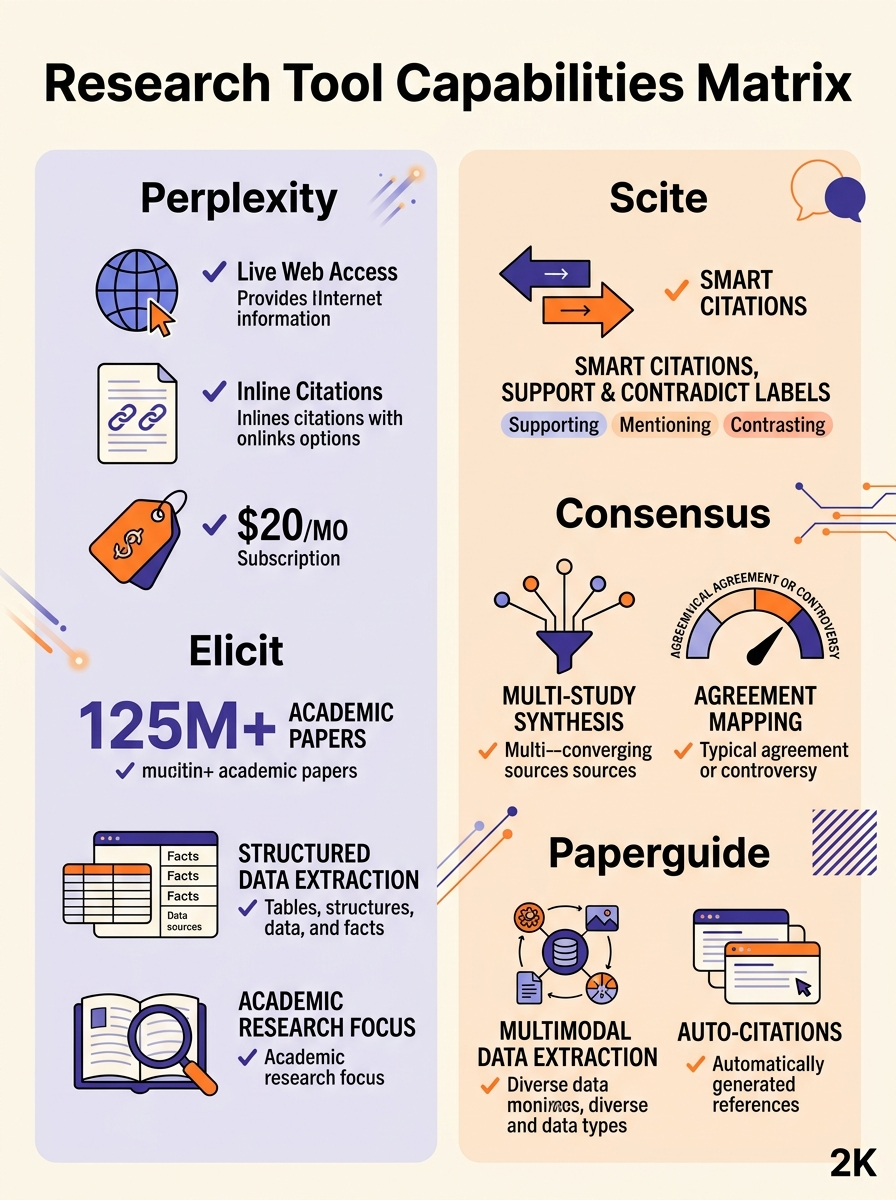
Perplexity works best as a real-time synthesis engine for current information. Unlike standard Large Language Models (LLMs), it searches the live web, returns cited sources alongside its answers, and supports project-based research. Its key advantage is transparency: users see exactly where information was retrieved, allowing instant verification. A free tier is available, with Pro plans around $20/month.[4]
Elicit: AI Agents for Academic Literature
Elicit is purpose-built for systematic literature reviews. It searches over 125 million academic papers and extracts structured data fields—such as study design, sample size, and outcomes—at scale. It helps researchers discover trends and contradictions in a field without manual database searching.[4, 16]
Scite: Building Trust with Smart Citations
Scite addresses “citation hallucinations” by using a large database of citation statements from scholarly papers. For every paper, it tells you whether subsequent research has supported, mentioned, or contradicted that work. This context helps you decide whether to rely on a source or investigate further.[4, 16]
Consensus and Paperguide: Synthesis and Extraction
Consensus answers research questions by analyzing what studies actually say, synthesizing findings across multiple studies to show the scientific consensus. Paperguide analyzes millions of papers to deliver comprehensive answers with proper citations and allows users to extract data from graphical and tabular information. Both platforms maintain academic integrity by automatically providing citations for all AI-generated content.[9, 16]
| Tool | Primary Function | Citation Transparency | Pricing |
|---|---|---|---|
| Perplexity | Real-time web synthesis | Inline source links with every answer | Free tier; Pro ~$20/month |
| Elicit | Academic literature extraction | Structured data fields with paper links | Free tier; Plus plans available |
| Scite | Smart citation context | Supported/contradicted labels per paper | Subscription-based |
| Consensus | Scientific consensus synthesis | Study-level agreement indicators | Free tier; Premium available |
| Paperguide | All-in-one research platform | Auto-citations for all outputs | Free tier; Pro plans available |
Key Takeaway: Purpose-built research tools like Perplexity, Elicit, Scite, Consensus, and Paperguide prioritize source transparency and citation accuracy—capabilities standard chatbots lack.[4, 9, 16]
Assistant vs. Agent: A Critical Distinction for Research
When building your pipeline, it is vital to understand the difference between an AI assistant and an AI agent. An AI assistant is reactive: it waits for your prompt, responds, and stops. A standard chatbot is an assistant. An AI agent, by contrast, is proactive—once given an objective, it plans, searches, and iterates without requiring a new prompt for each step.[4]
When to Use an Assistant
Assistants are best for single, well-defined questions that require a quick answer. If you need a definition, a brief summary, or a single fact verified, a standard chatbot or LLM interface suffices. However, assistants cannot manage multi-step workflows or synthesize findings across disparate sources autonomously.[4]
When to Deploy an Agent
Agents break problems into subtasks and synthesize findings autonomously. For research involving more than a single, well-defined question—such as literature reviews, trend analysis, or competitive intelligence—an agent is necessary. Platforms like MindStudio and Composio enable teams to build agents that plan multi-step research strategies, query multiple databases, and compile structured reports without continuous human prompting.[4, 16]
Frequently Asked: What’s the difference between an AI assistant and an AI agent for research?
An AI assistant responds to individual prompts and stops, while an AI agent autonomously plans, executes, and iterates multi-step research tasks. For complex workflows like literature reviews or trend analysis, agents are essential because they manage subtask decomposition and cross-source synthesis without requiring a new prompt at each step.[4]
Key Takeaway: Deploy AI agents—not assistants—for multi-step research tasks that require autonomous planning, searching, and synthesis across multiple sources.[4, 16]
Building a Verification Layer
Even with advanced tools, a human-in-the-loop verification layer remains necessary for high-stakes content. This layer ensures that automated research aligns with brand standards and factual accuracy before publication.[2]
Cross-Checking Claims
Automated systems should flag any claim that lacks a direct source link for manual review. This prevents the publication of unverified statistics or opinions presented as facts. Combining multiple AI detection tools with manual review strengthens citation and data consistency verification. Tools designed for detecting AI-generated content in research papers can serve as an additional guardrail.[7]
Inline Citation Management
Proper citation management ensures that sources are formatted correctly according to industry standards. Automated tools can handle formatting—whether APA, MLA, or hyperlinked references—saving editors significant time. Platforms like Paperguide maintain academic integrity by automatically providing citations for all AI-generated content, ensuring no claim goes unattributed.[2, 9]
Fact vs. Opinion Tagging
Automated systems can tag sections as “Fact” or “Insight” to help editors maintain a clear boundary between objective truth and strategic interpretation. This prevents the publication of unverified statistics or opinions presented as facts, and it gives editorial teams a quick visual scan of where subjective analysis enters the content.[2]
Key Takeaway: A verification layer combining automated claim-flagging, inline citation management, and fact/opinion tagging catches errors before publication and maintains editorial standards.[2, 7, 9]
Integrating Research into Your Workflow
To maximize efficiency, research tools must communicate directly with your Content Management System (CMS) or project management apps like Notion and Google Docs. Modern research platforms offer APIs that allow them to push verified content directly into drafting environments, enabling a continuous workflow where research and writing happen simultaneously.[2, 4]
API Connections and Interoperability
Tools like Composio act as integration layers, connecting AI research tools to Notion, Google Drive, and over 1,000 other applications. Notion AI, built directly into the Notion workspace, supports note-taking, drafting, and summarizing in the environment where teams already work—reducing friction between research and content production.[4, 6]
Workflow Automation
Automation rules can trigger research tasks based on content topics or keywords. For example, selecting a topic can automatically initiate a background search for recent industry reports, compile findings into a structured brief, and push that brief into your drafting environment. This ensures writers always have the latest verified data without manual searching.[2]
Key Takeaway: API-driven integration between research tools and drafting environments eliminates manual data transfer, creating a seamless pipeline from fact-finding to publication.[2, 4]
Avoiding Plagiarism in AI-Generated Research
AI-generated research can inadvertently plagiarize if not properly configured. AI models may reproduce text from training data without attribution, creating three categories of risk: verbatim copying, paraphrasing without citation, and idea theft.[1, 10]
Understanding AI-Enabled Plagiarism
AI-enabled plagiarism extends beyond direct text reproduction. According to research on AI plagiarism taxonomies, models can generate outputs that closely mirror the structure, arguments, or ideas of existing works without explicit copying. This is particularly dangerous in academic and technical content, where idea attribution carries significant weight. The onus is on researchers to use generative AI responsibly and ensure integrity in every output.[12]
Detection and Governance
AI detector tools can identify potential plagiarism in research outputs by flagging text that resembles existing sources too closely. However, detection alone is insufficient—organizations must implement governance policies requiring human review of all AI-generated citations and claims. Combining automated detection with manual oversight creates a robust defense against both accidental and systemic plagiarism.[7, 14]
Frequently Asked: How do you prevent plagiarism when using AI for research?
Restrict your AI tools to pulling from licensed or open-access databases, require inline citations for every factual claim, deploy AI detector tools as a secondary check, and implement governance policies mandating human review of all AI-generated citations before publication.[2, 7]
Key Takeaway: Preventing AI-enabled plagiarism requires restricting source databases, mandating inline citations, and combining automated detection with human governance review.[1, 2, 7]
Scaling Content Production with Ethical Automation
Ethical research automation reduces fact-checking time by up to 70% in enterprise workflows, enabling high-volume content production without compromising trust or integrity. Automated research gathers verified information faster than manual methods, allowing teams to produce more content in less time while maintaining quality standards.[2]
Reducing Time-to-Publish
When research tools feed directly into drafting environments via APIs, the gap between topic selection and first draft shrinks dramatically. Teams can produce more content in less time while maintaining quality, because the research layer has already verified facts, gathered citations, and structured the information into a usable brief.[2]
Maintaining Brand Reputation
Original, cited content builds domain authority and trust with audiences over time. Readers return to sources they know they can rely on for truthful information. Consistently accurate content leads to higher conversion rates, while avoiding plagiarism protects against SEO penalties and legal issues that can permanently damage a brand’s online presence.[2]
Key Takeaway: Ethical automation cuts fact-checking time by up to 70% while protecting brand reputation through consistently original, cited content.[2]
Future Trends in Research Automation
AI agents will become more sophisticated in managing multi-step research tasks, and integration with real-time data sources will further reduce plagiarism risks as the field matures through 2026 and beyond.[4, 16]
Agentic Research Pipelines
Future tools will autonomously plan, execute, and verify research with minimal human intervention. Agents will handle complex queries across multiple databases and formats, synthesizing findings into publication-ready briefs. The AI detector market is projected to reach $2.06 billion by 2030, signaling significant platform-level investment in identifying unverified or synthetic content.[18]
Real-Time Source Verification
Tools will cross-check claims against live databases and news sources in real time, ensuring content is always current and accurately cited. Search engines are updating ranking factors to prioritize demonstrated expertise (E-E-A-T), meaning content backed by strong research signals will perform better in these new environments.[2, 20]
Key Takeaway: The future of research automation points toward autonomous agentic pipelines and real-time source verification, driven by growing market investment in AI detection and verification technologies.[4, 18, 20]
Conclusion
Implementing Automatic Research Tools That Feed Your AI Content Pipeline (Without Plagiarism) is essential for modern businesses seeking scale without sacrificing integrity. By prioritizing factual accuracy, inline citations, and brand voice consistency, organizations can protect their reputation while maximizing efficiency.[2] The tools exist today—Perplexity for real-time web synthesis, Elicit for academic literature, Scite for smart citations, and platforms like Composio for workflow integration. The question is no longer whether to automate research, but whether you can afford the risk of publishing AI-generated content without a verified research layer beneath it. Audit your current workflow today to identify gaps where “generative guessing” is replacing verified fact-finding, and start building a research-driven engine that delivers trustworthiness at scale.[2]
Sources
- [1] AI-generated research paper fabrication and plagiarism - PMC — https://pmc.ncbi.nlm.nih.gov/articles/PMC10028415/
- [2] Automatic Research Tools That Feed Your AI Content Pipeline - Autoriax — https://autoriax.com/blog/automatic-research-tools-that-feed-your-ai-content-pipeline-without-plagiarism/
- [4] Best AI tools for research in 2026 - Composio.dev — https://composio.dev/content/best-ai-tools-for-research
- [6] Top 10 AI Word Document Generators - AIMultiple — https://aimultiple.com/ai-word
- [7] How to Detect AI in Research Papers Easily - Hastewire — https://hastewire.com/blog/how-to-detect-ai-in-research-papers-easily
- [9] Paperguide: The AI Research Assistant — https://paperguide.ai/
- [10] AI-Enabled Plagiarism: Taxonomy, Detection Limitations, and Governance Implications - Adnan Masood, PhD — https://medium.com/@adnanmasood/ai-enabled-plagiarism-taxonomy-detection-limitations-and-governance-implications-af3eff47e826
- [12] Policing plagiarism of ideas in GenAI research - Northwestern.edu — https://news.northwestern.edu/stories/2026/05/policing-plagiarism-of-ideas-in-generative-ai-assisted-research-writing?fj=1
- [14] Top 6 AI Detector Tools for Editors, Educators, and Content Teams - Washington City Paper — https://washingtoncitypaper.com/article/782753/top-ai-detector-tools-for-editors-educators-and-content-teams/
- [16] 9 AI Agents for Research and Analysis - MindStudio — https://www.mindstudio.ai/blog/ai-agents-research-analysis
- [18] AI Detector Market worth $2.06 billion by 2030 - MarketsandMarkets — https://www.marketsandmarkets.com/PressReleases/ai-detector.asp
- [20] AI Research Tools and SEO Insights - Autoriax.com — https://autoriax.com/blog/
Try Autoriax free — no credit card required
Get your first article in minutes. See the research depth before you commit.
Get 3 free articles3 articles free • No credit card • Cancel anytime